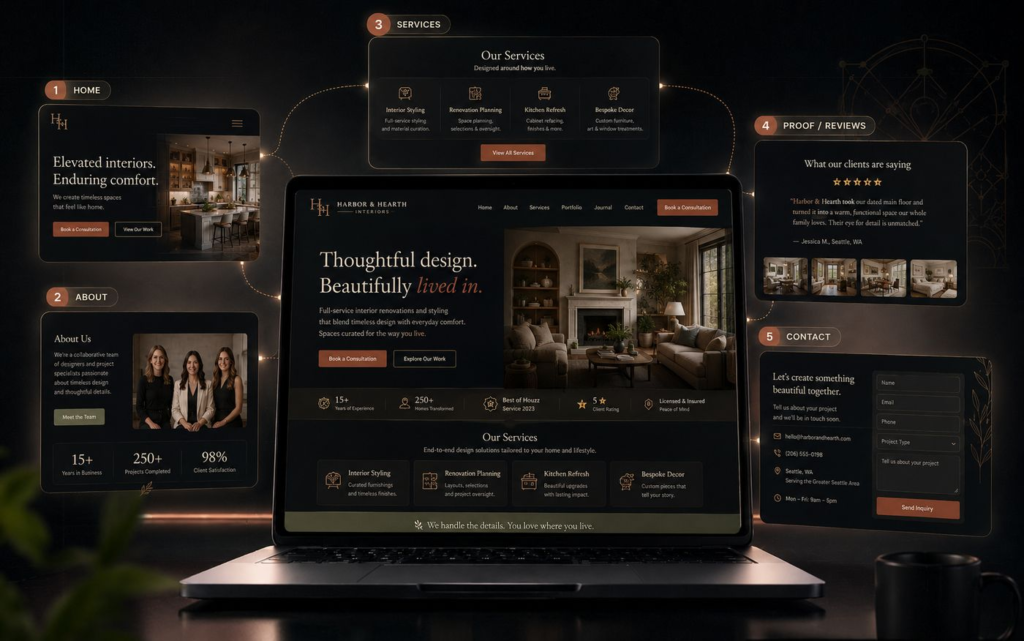
Almost every small business site I’m asked to fix has the same problem: too many pages, each doing half a job. A visitor lands somewhere in the middle, can’t tell where to go next, and leaves. Five pages, each with one clear purpose, will out-perform fifteen every time.
The number isn’t magic. What matters is that every page has a single job and a single next step. Once you can name the job of each page in one sentence, the structure of the site writes itself.
The five pages
1. Home — orientation
The home page tells a first-time visitor what you do, who it’s for, and what to do next. It’s a routing decision, not a brochure. Everything below the first screen exists to support one of those three answers.
2. Services — what you actually sell
One page listing what you offer, in the language customers use, with enough detail that nobody has to message you to find out whether you do the thing they want. If you have three or four distinct services, give each one its own section with its own booking link.
3. Pricing — the page people look for first
Hiding prices doesn’t create curiosity, it creates hesitation. You don’t need an exact figure for every job — a starting price, a typical range, or “from” pricing is enough to filter out the wrong enquiries and reassure the right ones.
4. Proof — work, reviews, before and after
Photographs of real work do more than any description of it. Whatever form your proof takes — a gallery, a set of reviews, a handful of short case studies — keep it specific and keep it recent.
5. Contact — one obvious way to reach you
Name the fastest channel and put it first. For most local businesses that’s WhatsApp or a phone call, not a contact form. Add your address, your hours, and a map if people visit you in person.
What each page needs to have in common:
- One job, stated in the first sentence.
- One primary action, visible without scrolling on a phone.
- A route back to the page that answers the next likely question.
- Nothing that exists only because other websites have it.
Structure beats volume. Five pages that each answer one question clearly will bring more enquiries than fifteen that each half-answer three.
What you can leave out
A team page for a two-person business. A blog you’ll update twice and abandon. A downloadable PDF brochure. An FAQ that repeats what the services page already said. A gallery of stock photography that could belong to any business in your industry. None of these lose you customers directly — they just add distance between a visitor and the booking button.
When to add a sixth
Add pages when the same question keeps arriving in your inbox, or when one service is big enough to deserve its own entry point from search. A dedicated page for the treatment you’re known for, or the area you serve most, earns its place. A page added because the template had a slot for it does not.
If you’re not sure which of your current pages are pulling weight, that’s part of what I look at in a free growth audit — including which ones to merge or delete.